


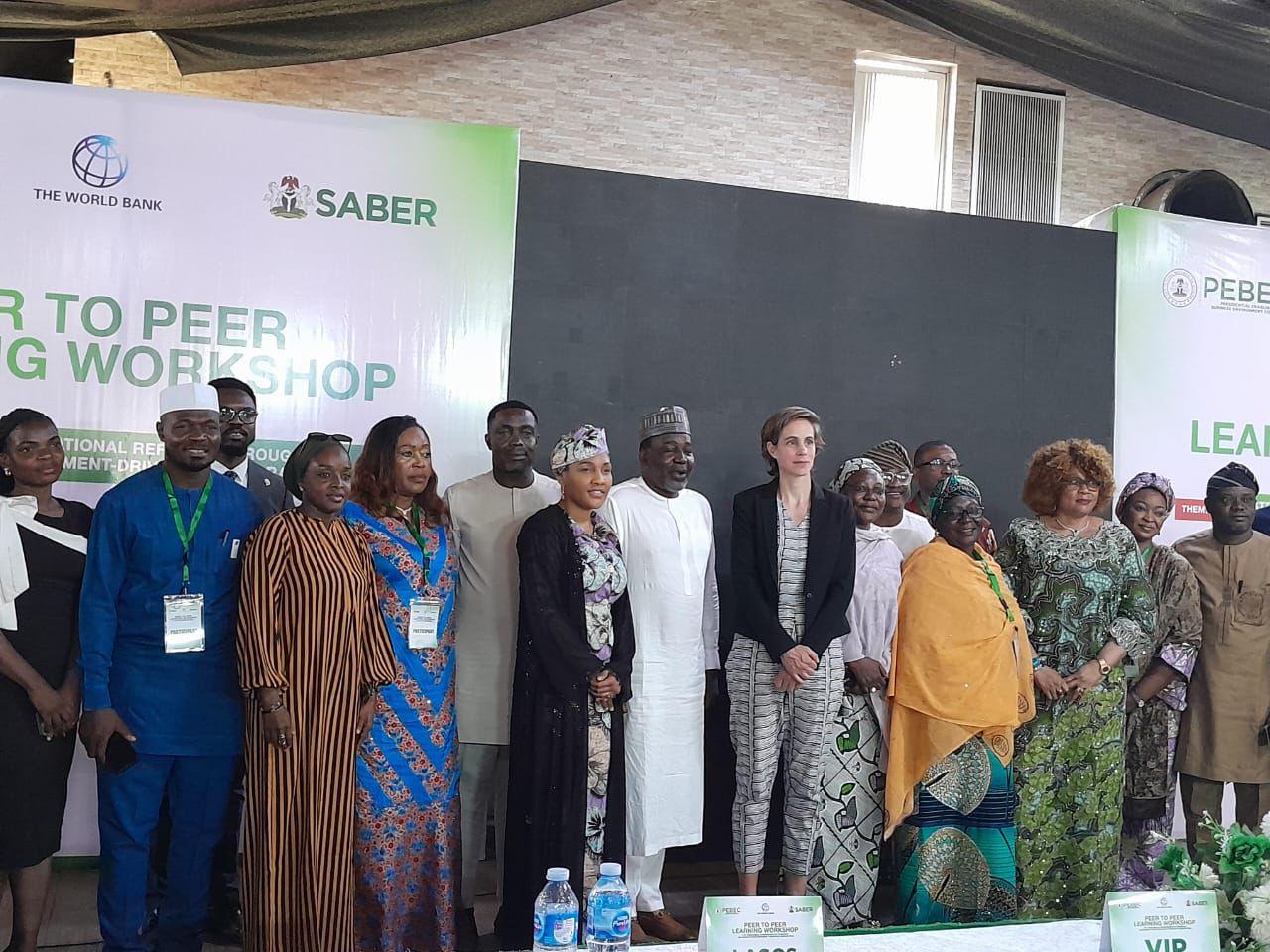
Presidential Enabling Business Environment Council, PEBEC in collaboration with State Action on Basic Enabling Reforms, SABER, has held a Two-day peer to peer learning workshop for Commissioners of Commerce and Heads of Investment Promotion Agencies, IPA, from April 28-29 in Abuja.
The aim of the workshop is to create a platform for synergy building between the national and subnational governments departments, which deal with the establishment of enabling atmosphere for ease of doing business in Nigeria
This is to facilitate the provision of an environment which favours the growth of investment opportunities for both local and for Foreign Direct Investment, FDI.
The Director General of PEBEC, Princess
Zahrah Mustapha Audu, in her remarks during the workshop emphasised on the need for such collaborations to enable economic growth and development to be home grown and locally driven.
“From what we have seen since my inception last year, we are trying to monitor what we have done with the subnational,” the D-G said. ”
The event which had the presence of Commissioners of Commerce and Heads of IPAs from most states in Nigeria, involved various sessions where working models of investors attraction through to retention and expansion were presented by various resource persons and stake holders within the investment corridors and ecosystem of Nigeria.
“If you recall, last year we went on a nation-wide tour, which we will repeat again at the end of May, these engagements specifically was designed to try and bridge the gap, we have some states that are clearly excelling and others are maybe lagging behind, and there is no better way to show somebody how to do it than by using practical, real-life examples. So we believe that our sub-nationals, the commissioners who are here present, the Heads of the IPAs who are here present, had a lot to learn, we had a lot to learn and had a lot to share, which is also very important, so we believe that we will start to take steps towards transformation,” she added.
The commissioners and Heads of IPAs took turns to share their unique experiences towards investment drives in their various states, the institutional structures that they they have put in place and the steps they have taken to navigate bureaucratic processes in their work with Ministries, Departments and Agencies, MDAs in their states.
“For Nigeria to grow, it has to be holistic, it cannot just be federal policies at the federal level, and it cannot be one or two.states excelling. We have to hand-hold ourselves. Yes, there is a level of competition, and there has to be because competition is health, but there also has to be a level of collaboration right?, because at the end of the day, all we know is that we want to attract investment into Nigeria, and as such, this was quite a successful outing for us, she further stated.
On the sideline of the workshop, journalists had interview sessions with some of the commissioners of commerce and Heads of IPAs who expressed their satisfaction with the conduct of the event, while emphasising their commitments to ensuring the strict implementation of the templates they have shared and learnt during the sessions in their states in order to drive investment attraction, retention and expansion.
In his closing remark, the Deputy Chief of Staff to the President, Office of the Vice President, Senator Ibrahim Hadejia, who was also in attendance at the workshop expressed the goodwill of the chairman of PEBEC, Vice President Kashim Shettima GCON.
“It is a distinct honour to address you at the close of this strategic Peer-to-Peer Learning Workshop convened under the auspices of the Presidential Enabling Business Environment Council, PEBEC, through the State Action on Business Enabling Reforms, SABER, Programme.
Let me begin by bringing you warm greetings from the chairman of the Council His Excellency Vice President Sen. Kashim Shettima, GCON, under his able leadership PEBEC has sustained institutional leadership in driving regulatory reform and improving Nigeria’s business climate.
The Council has continued to strengthen intergovernmental coordination, deepen reform implementation, and promote a more predictable and transparent operating environment for businesses. I extend deep appreciation to all participants whose engagement over the past two days, this reflects a shared commitment to advancing subnational competitiveness.
Distinguished participants, one fundamental reality has emerged with increasing clarity: Nigeria’s economic transformation will be driven not only by federal policy direction, but by the effectiveness of execution at the subnational level.
It is within our states that investment decisions are operationalised, regulatory frameworks are experienced, and economic value is ultimately created. Our states, therefore, are not peripheral actors, they are central to the architecture of national competitiveness.
This is precisely why the SABER Programme represents a critical policy instrument. It is designed to incentivise reform, strengthen institutional capacity, and align state-level systems with global standards of investment facilitation. By improving regulatory quality, enhancing transparency, and reducing transaction costs, we are collectively positioning Nigeria as a more attractive destination for both domestic and foreign investment.
Over the course of this workshop, deliberations have appropriately moved beyond policy articulation to focus on implementation frameworks.
Discussions have addressed key pillars of modern investment promotion, including: The development of differentiated and data-driven state value propositions; Strengthening inter-agency coordination mechanisms; Leveraging digital platforms for investor engagement and service delivery; Establishing robust investment tracking and performance management systems; and Institutionalising investor aftercare to ensure retention and expansion.
These are not abstract priorities, they are the operational foundations of a competitive investment ecosystem.
Under the leadership of His Excellency, Bola Ahmed Tinubu, GCFR, and His Excellency, Kashim Shettima, GCON, this administration remains firmly committed to structural reforms that unlock private sector growth, expand economic opportunity, and deliver inclusive prosperity for all Nigerians.
PEBEC continues to play a catalytic role in this regard, driving regulatory simplification, improving service delivery across Ministries, Departments and Agencies, and strengthening investor confidence through measurable reforms.
The SABER Programme further reinforces this national agenda by embedding reform incentives at the subnational level, where the investor experience is most directly shaped. Consequently, subnational reform is no longer discretionary; it is a strategic imperative.
Every state possesses unique comparative advantages, whether in natural resources, human capital, geographic positioning, or sectoral opportunities.
The critical task before us is to systematically translate these assets into bankable, investable opportunities through strong institutions, efficient administrative systems, and sustained political will.
I am particularly encouraged by the decision to establish a Commissioners and IPA Peer Network, alongside clearly defined state-level reform commitments.
This signals a transition from dialogue to structured collaboration, one that prioritises accountability, knowledge-sharing, and measurable outcomes.
As you return to your respective states, I urge you to approach the next phase of this work with discipline, urgency, and strategic focus.
Let this engagement not conclude as a workshop, but evolve into a coordinated reform movement.
We must see: Stronger and more credible investment pipelines; Reduced approval timelines through process optimisation; Enhanced inter-agency coordination and service integration; Digitally enabled, investor-facing platforms that improve transparency; and Tangible reforms that translate into jobs, enterprise growth, and improved livelihoods. Ultimately, Nigeria’s competitiveness will rise in direct proportion to the competitiveness of its states.
On behalf of the Office of the Vice President, I reaffirm our unwavering support for initiatives that strengthen the business environment, unlock investment flows, and accelerate sustainable economic growth across the federation. I thank you for your commitment, your service, and your continued contribution to national development. I wish you safe travels and every success in the work ahead.
Thank you, and may God bless the Federal Republic of Nigeria,” he concluded.

